Material passports for buildings
EU regulation will require a digital product passport for every construction product. I built the prototypes that make that idea tangible.
- Product Passport
- Concept, design, and code
- 2025 to 2026
- Craft
- Live
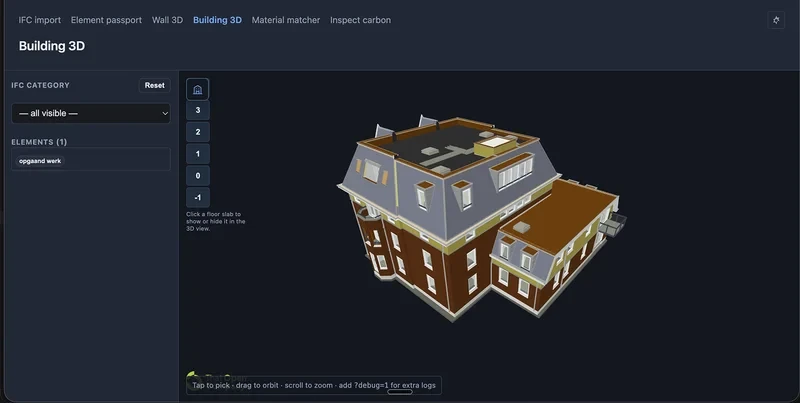
Overview
EU regulation will require a digital product passport for every construction product. A building is a combination of thousands of products, so a building is a collection of material passports. I built the prototypes that make that idea tangible: upload an architect’s file, walk through your building, see its ecological footprint.
The live prototype link is not published yet.
Context
It started at a hackathon. With Stefanos and Omar, three people in three countries working async, we built Textile Tracer at a blockchain hackathon. I made the design, then we coded the smart contracts together. Every actor signs their step during the lifecycle of a t-shirt, and the data gets pinned on the IOTA blockchain so it becomes tamper proof and outlives the companies that wrote it. A consumer scans a QR and sees the full product trace. Our team won the top award out of 60+ teams.
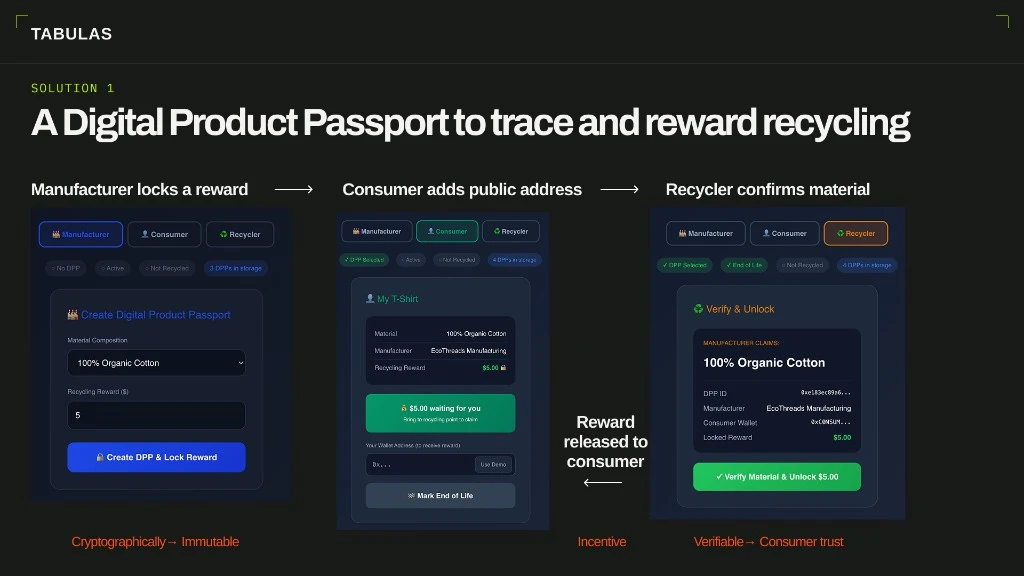
What the project taught me after the win:
- People do not care about the technology. They care about verified information when it is presented in a simple way. Blockchain tech is very powerful but currently only used by early adopters.
- A t-shirt’s recycling cycle is long and its residual value is small. The economics only work at massive scale.
- The multi-stakeholder model worked. Every actor signing their own step meant the passport could be updated across a product’s whole lifecycle, not just at the point of sale. That idea outlasted the t-shirt.
The pivot. I applied it to an industry where materials hold real value and traceability is becoming law: construction. No one had designed a platform where that same lifecycle model, multiple independent stakeholders updating one artifact, could work at building scale. A producer, consumers, a repair service, a recycler at intake, a regulator with a checklist. One passport, multiple views: the same data, different entry points.
Solution
The hard problem is matching material names across the lifecycle. The architect’s model says Concrete, type C30. The lifecycle databases say Cement CEM II. One Swiss database alone has 200 variants. Different languages, different nomenclatures, same physical material. So I built a translation layer that matches the different namings to one identity. Everything downstream depends on this working first.
Concrete, type C30. Cement CEM II. 200 Swiss variants. One identity.
An architect uploads a BIM file, the industry’s standard 3D model format.
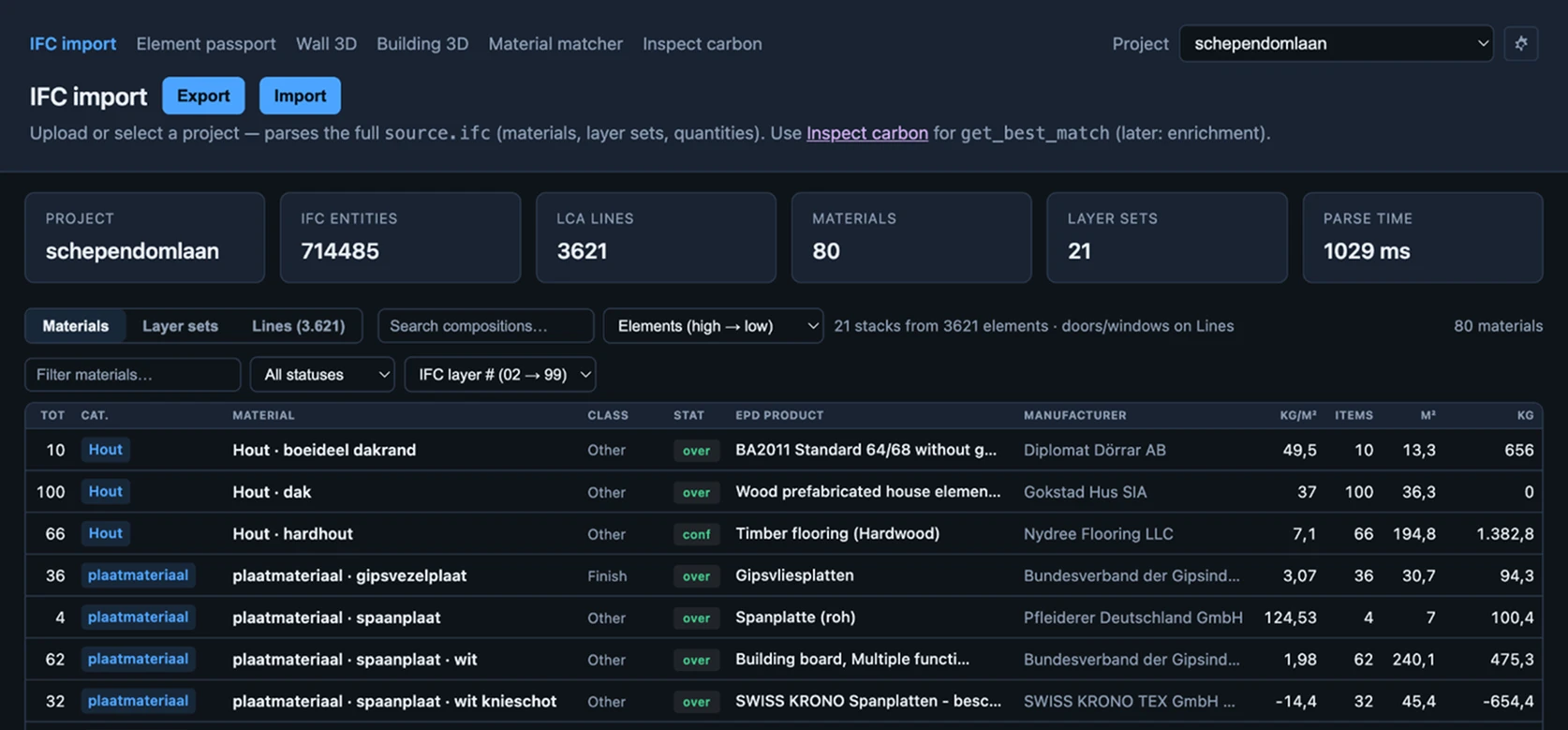
The system parses it and matches every material to a passport with lifecycle data from producer databases. A CO2 calculator adds it up. You walk through the actual building in the browser, drill down from house to product to passport, and see the total ecological footprint.
Products stay traceable across location and time. Buildings, it turns out, do not fit in a PDF.
Two more prototypes complete the picture. Producer Environmental Product Declarations (EPDs) are technical material files locked in PDFs, so I turned them into structured data that machines can read and people can question in plain language. Because buildings change (repairs, reselling, demolition) I built an event timeline where each actor logs those moments, so the passport collection stays true across a building’s life.
Impact
The chain works end to end: from an architect’s file to a verifiable footprint, on open standards, in the browser. Textile Tracer’s award added outside validation of the multi-stakeholder mechanism. The honest negative result in my research mattered most. It moved the work to the domain where it counts.
Role
Concept, design, and code, solo, across the viewer, the EPD work, and the timeline. Textile Tracer was the three of us together. To work with 3D building models in the browser I took the That Open Company course.
Reflection
The bigger reflection is about timing. Everything here depends on laws that are still years from enforcement, and laws can change. I proved the chain works but cannot make the market arrive faster. I would rather spend the next years inside a company that already has traction than wait for regulations.